
Turn last season’s display into next season’s best plan
The best-looking holiday displays aren’t just “installed and forgotten.” They’re refined year over year. If your 2025 setup looked great but felt stressful (or if it didn’t hold up to Denver’s wind, snow, and freeze-thaw cycles), a simple post-season review can save time, reduce replacements, and make your 2026 display cleaner, brighter, and safer. This guide walks through a practical holiday lighting review and display evaluation process you can use to plan improvements early—well before ladders come out again.
Step 1: Capture your “after-action” notes while it’s still fresh
Before you change anything, write down what happened in 2025—especially the small details you’ll forget by fall. Think of it as a quick scorecard you can share with your installer (or use yourself) when it’s time to design next year’s layout.
Quick review prompts (5–10 minutes)
- Visibility: What looked best from the street? What disappeared at night?
- Balance: Did one roofline/section feel too bright compared to the rest?
- Reliability: Where did outages or flicker happen (specific peaks, gutters, trees, entryway)?
- Timing: Were you happy with on/off times? Did timers drift after temperature swings?
- Safety & convenience: Any tripping hazards, pinched cords, or hard-to-reach plugs?
- Reactions: What did family, neighbors, customers, or tenants compliment?
Step 2: Do a true display evaluation (not just “did it work?”)
A great display evaluation looks at performance, curb appeal, and future flexibility. Start with the “big shapes” people see first: rooflines, peaks, entry outlines, windows, columns, and trees. Then zoom in to the details: connection points, extension runs, clips, and attachment surfaces.
What to evaluate on every property
- Story: What’s the focal point—entry, tree, roofline, storefront, or signage?
- Proportions: Are bright accents pulling attention away from your focal point?
- Consistency: Do color temperatures match (warm vs. cool whites) across zones?
- Durability: Did clips shift, adhesives fail, or cords rub on sharp edges?
- Serviceability: If one section goes out, can it be isolated and fixed quickly?
Step 3: Safety and compliance check (the “boring” part that protects everything)
Holiday lighting is meant to be festive—not risky. National safety guidance repeatedly emphasizes inspecting light strings for damage and using sets rated for the conditions they’re exposed to. If anything in 2025 showed cracking, fraying, loose sockets, or frequent outages, mark it for replacement instead of “making it work” again next year. Also make sure outdoor décor is plugged into GFCI-protected circuits, and use lights certified for outdoor conditions. (For example, NFPA and UL safety guidance highlights inspecting lights before use and choosing appropriate outdoor-rated products and protection.)
Checklist: what to retire after 2025
- Any strand with nicks, cuts, brittle insulation, or exposed conductors
- Sets that overheated at plugs or showed discoloration
- Sections that repeatedly flickered after weather events
- Anything not clearly labeled for outdoor / wet-location use when installed outdoors
- Extension cords not rated for outdoor use or showing jacket damage
A practical scoring table: rate your 2025 setup and decide what to upgrade in 2026
| Area | What to review | Red flags from 2025 | 2026 improvement idea |
|---|---|---|---|
| Roofline | Straightness, spacing, clip security | Sagging sections, dark gaps, wind shifts | Custom-fit runs, improved attachment points, cleaner wire management |
| Entry / columns | Warmth and symmetry at the front door | Too dim vs. roofline, cords visible | Add defined framing, hide cords, balance brightness zones |
| Trees | Wrap density, canopy glow, trunk-to-branch continuity | Patchy coverage, outages near connectors | Plan power feeds, use consistent wrap spacing, consider color-changing zones |
| Timers / control | Scheduling, consistency, daylight changes | Random shutoffs, drift, hard-to-access outlets | Upgrade control strategy, consolidate circuits, simplify access |
| Commercial frontage | Brand-friendly look, visibility, pedestrian safety | Glare, blocked signage, trip hazards | Emphasize entrances and signage, tidy runs, keep walkways clear |
Tip: Assign a simple 1–5 score for each area, then upgrade the lowest-scoring zones first. That approach keeps 2026 planning focused, realistic, and budget-friendly.
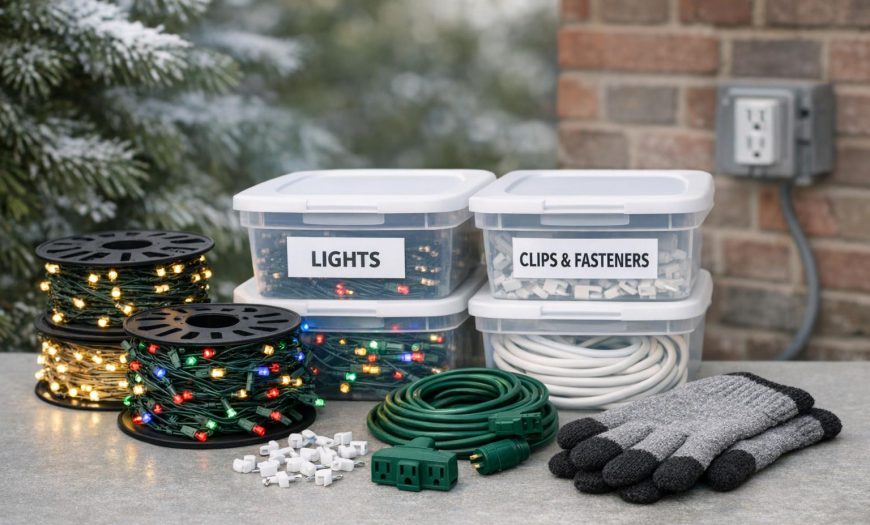
Step 4: Storage and maintenance review (where future problems start)
Many “mystery outages” in December are actually storage issues from the previous season: crushed bulbs, kinked wire, moisture trapped in bins, or unlabeled bundles that get yanked apart. A good review asks two questions:
- Was takedown gentle and organized? (No rushing, no tangles.)
- Was storage dry, labeled, and pest-resistant? (No damp garage corners or open containers.)
Best practices to adopt for 2026 planning
- Label by zone: “Front roofline,” “Entry columns,” “Maple tree trunk,” etc.
- Bundle with intention: Keep runs that install together stored together.
- Keep it dry: Let sets fully dry before bins are sealed.
- Track replacements: Note what failed so you’re not guessing next fall.
Denver-specific considerations: wind, snow load, and freeze-thaw reality
Denver’s holiday season can bounce between mild afternoons and sharp overnight freezes. That matters for attachment methods, exposed connection points, and cable routes that can stiffen in cold weather. During your 2025 review, note where wind repeatedly tugged lines or where ice buildup created stress points. If a section failed after a storm, it’s often a sign that the layout needs better strain relief, improved clip placement, or a different routing plan—not just a replacement strand.
Local upgrade ideas that tend to pay off
- Reduce exposed connections on rooflines and at tree bases
- Plan for snow shedding from roof edges so lights don’t become a catch point
- Protect walkways by routing cords away from foot traffic and meltwater paths
- Prioritize service access for commercial sites where uptime matters
Ready to plan a brighter 2026 display (without repeating 2025 headaches)?
Denver Christmas Light Installers provides design consultation, professional installation, in-season maintenance, takedown, and off-season storage across the Denver metro area. Share your notes from this review and we’ll help turn them into a clean, durable plan for next season.
Want inspiration while you plan? Browse the gallery and save examples of rooflines, trees, and commercial looks you like.
FAQ: Holiday lighting review & 2026 planning
When should I evaluate my holiday lights after the season?
Ideally right after takedown, when you still remember what failed, what shifted in wind, and which areas felt too dim or too bright. If that window has passed, you can still do a useful review by looking at photos and noting problem zones.
What’s the difference between a display evaluation and just replacing broken strands?
Replacing strands fixes a symptom. A display evaluation looks at design balance, attachment strategy, routing, control/timing, and serviceability—so the same issues don’t keep returning each year.
How do I know if lights are appropriate for outdoor use?
Check the packaging or tag for an outdoor rating (often indicated by certification marks and location language such as “suitable for wet locations” where applicable). If it’s unclear, don’t assume it’s outdoor-safe—especially for rooflines, trees, or any place exposed to precipitation.
What should homeowners do to reduce mid-season outages?
Prioritize organized storage, label by installation zone, retire damaged sets, and minimize exposed connection points. In Denver, it also helps to plan routing and attachment methods that hold up during wind and freeze-thaw changes.
Can a professional installer reuse existing lights?
Often yes—if they’re in good condition and appropriate for the intended location. A professional can also help you decide what’s worth keeping, what should be replaced for safety, and where upgrades will make the biggest visual impact.
More questions? Visit our FAQ’s page or reach out through the contact form.
Glossary (helpful terms for planning)
Display evaluation
A structured review of your lighting design, attachment strategy, reliability, safety, and visual balance to guide improvements for the next season.
GFCI
Ground-Fault Circuit Interrupter. A protective device that reduces shock risk by cutting power when it detects a ground fault—especially important for outdoor outlets.
Wet vs. damp location rating
Language used to describe how much direct water exposure a product can handle. “Wet” typically means exposed to direct rain/splashing; “damp” generally indicates moisture or humidity but not direct water contact.
Zone labeling
A storage method where lights are tagged and packed by where they install (roofline, entry, shrubs, trees), making next season faster and reducing damage from tangling and pulling.

Leave feedback about this