
A festive, welcoming Denver starts with well-planned light
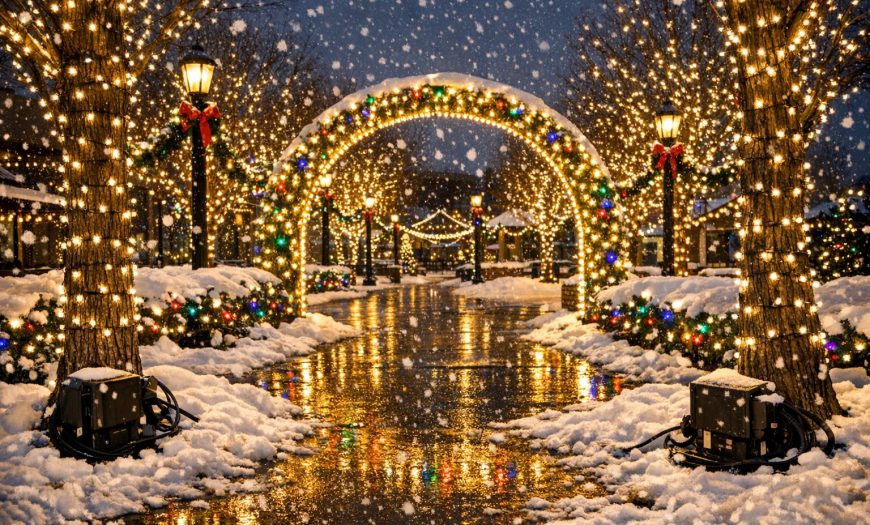
Holiday lighting in public spaces does more than “look nice.” It helps community events feel safer, more navigable, and more memorable—especially when crowds, cold weather, and early sunsets collide. From park walkways and civic plazas to neighborhood tree lightings and outdoor markets, the best displays balance three priorities: reliable power, weather-ready materials, and a design that guides people through the experience.
What makes public-space holiday lighting different from residential décor?
Public venues and community events have a different set of constraints than a single home: higher foot traffic, stricter safety expectations, more complex power distribution, and a need for the display to “read” well from multiple angles. The goal isn’t just sparkle—it’s a cohesive visual plan that supports crowd flow and event programming.
Public-space must-haves
• Clear pathways and gathering zones
• Weather-resistant connections and cable routing
• Circuit planning for multiple zones (not one outlet)
• Maintenance plan for outages during event hours
• Consistent look across trees, poles, entries, and structures
• Weather-resistant connections and cable routing
• Circuit planning for multiple zones (not one outlet)
• Maintenance plan for outages during event hours
• Consistent look across trees, poles, entries, and structures
Common pitfalls to avoid
• Exposed plug connections in snow/slush areas
• Overloading a single circuit with “just one more strand”
• Unlabeled zones (hard to troubleshoot fast)
• Loose runs near sidewalks (trip hazards)
• Mixed color temperatures that look mismatched on camera
• Overloading a single circuit with “just one more strand”
• Unlabeled zones (hard to troubleshoot fast)
• Loose runs near sidewalks (trip hazards)
• Mixed color temperatures that look mismatched on camera
Planning the display: design zones that support the event
A strong community-event lighting plan starts by dividing the venue into “zones” so each area has a job. When the zones work together, visitors naturally understand where to enter, where to gather, where to shop, and where to take photos—without needing extra signage.
Recommended zones for Denver community events
1) Arrival + entry “moment”: lit arches, wrapped poles, or roofline lines that read from the street.
2) Wayfinding paths: consistent, lower-glare lighting along walkways (trees, railings, fence lines).
3) Main gathering area: a focal tree wrap, canopy effect, or color-changing centerpiece for countdowns and announcements.
4) Vendor/market lanes: warm, inviting light that supports browsing—balanced brightness for photos.
5) Photo backdrops: a deliberate “selfie spot” reduces crowding at entrances.
Color strategy that looks good in real life and on camera
For civic spaces, “warm white” and “classic multi-color accents” tend to photograph well and feel welcoming. For events with sponsors or themed nights, color-changing elements can be limited to focal points so the venue still feels cohesive.
Tree lighting that scales beautifully
Trunk-and-limb wraps provide structure, while canopy lighting adds “wow” from a distance. In public spaces, consistent spacing and uniform brightness matter more than cramming in extra strands.
Power, safety, and reliability: the “behind-the-scenes” that protects your event
The best-looking display isn’t the one with the most lights—it’s the one that stays on consistently through cold snaps, wind, and snow. Event lighting should be engineered for outdoor exposure, wet conditions, and fast troubleshooting.
| Planning Item | Why It Matters | Best Practice for Public Spaces |
|---|---|---|
| GFCI protection | Reduces shock risk and helps detect ground faults in wet conditions | Verify outdoor receptacles are GFCI-protected; test before event days and after major moisture events |
| Outdoor-rated cords & connectors | Indoor cords can fail in snow/slush and create hazards | Use cords marked for outdoor/wet locations and protect connection points from moisture |
| Load planning (watts/amps) | Prevents nuisance trips and overheated cables | Divide the venue into circuits/zones; label everything for fast resets |
| Timers/scheduling | Controls operating hours and reduces energy waste | Program for event hours + a buffer for setup/cleanup; avoid running all night unless required |
| Maintenance plan | Events can’t “wait until next weekend” to fix outages | Have spare parts, zone maps, and a rapid-response process during peak nights |
Why LEDs are the default for community events
LED holiday lights typically use far less electricity than incandescent options, which makes circuit planning easier for large public displays and reduces operating costs. LEDs also run cooler, which is helpful when lighting is installed around greenery, décor, and high-traffic areas.
Execution checklist: from setup to takedown
Community lighting projects are smoother when you treat them like a temporary infrastructure build—especially in Denver, where weather can change quickly.
Before install
• Walk the site and mark power sources
• Identify trip-hazard areas and pedestrian routes
• Confirm event hours and “lights-on” moments
• Decide your focal points (tree, entry, stage)
• Plan zones and label them on a simple map
• Identify trip-hazard areas and pedestrian routes
• Confirm event hours and “lights-on” moments
• Decide your focal points (tree, entry, stage)
• Plan zones and label them on a simple map
Installation day
• Start with the focal element, then “connect the dots” outward
• Protect plug connections from moisture exposure
• Secure runs away from foot traffic and snowplow paths
• Test each zone as it’s completed (don’t wait until the end)
• Protect plug connections from moisture exposure
• Secure runs away from foot traffic and snowplow paths
• Test each zone as it’s completed (don’t wait until the end)
During the event
• Keep a small troubleshooting kit on-site
• Assign one point person for lighting resets
• Re-check problem areas after heavy snow or wind
• Document what worked for next year’s layout
• Assign one point person for lighting resets
• Re-check problem areas after heavy snow or wind
• Document what worked for next year’s layout
Quick “Did you know?” facts for event planners
LEDs can simplify power logistics
Lower energy draw often means fewer overloaded circuits and fewer nuisance trips—especially helpful when you’re lighting multiple trees, entries, and vendor lanes.
Most outages happen at connection points
In snowy climates, moisture intrusion at plugs and splitters is a major culprit. Protecting and elevating connections can improve reliability.
A photo spot reduces crowding elsewhere
When the best “Instagram moment” is intentional, entrances and vendor lanes stay clearer during peak minutes.
The local Denver angle: weather, timing, and public-space expectations
Denver’s holiday season brings unique conditions: fast temperature swings, wind events, and snow that can melt and refreeze. For community venues, reliability is the headline—especially for weekend events and high-visibility public areas.
Denver-specific planning tips
• Plan for snow management: route cords away from plow lines, curb ramps, and meltwater zones.
• Build in a maintenance window: schedule a quick check after the first major snow and again before your biggest attendance night.
• Think “visible at 4:30 PM”: early darkness means your entry moment should be instantly recognizable from parking/drop-off areas.
• Choose durable mounting methods: wind + freeze/thaw cycles can loosen temporary fasteners if they aren’t installed correctly.
• Build in a maintenance window: schedule a quick check after the first major snow and again before your biggest attendance night.
• Think “visible at 4:30 PM”: early darkness means your entry moment should be instantly recognizable from parking/drop-off areas.
• Choose durable mounting methods: wind + freeze/thaw cycles can loosen temporary fasteners if they aren’t installed correctly.
Permits & venue rules
Many public spaces and parks require coordination, approvals, or specific rules for temporary event setups. If your lighting is part of a permitted community event, confirm the venue’s requirements early so your installation plan (and timelines) match what’s allowed on-site.
Make your Denver event look professional—and run reliably all season
Denver Christmas Light Installers designs, installs, maintains, removes, and stores custom holiday lighting for community spaces, commercial properties, and event venues across the Denver metro area.
FAQ: Holiday lighting for Denver community events
How early should we schedule installation for a public event in Denver?
For peak holiday weeks, scheduling early helps secure preferred dates and provides time for site walks, power planning, and any venue approvals. If your event is tied to a specific weekend, it’s smart to plan for an install window that leaves time for a test night and a quick maintenance pass.
What’s the safest way to run power across a plaza or park walkway?
The safest approach is a zone-based plan that keeps cords away from pedestrian paths whenever possible, uses outdoor-rated equipment, protects connection points from moisture, and relies on GFCI-protected circuits. For public venues, reducing trip hazards and protecting plugs from snow/slush are top priorities.
Can we do color-changing lighting for Denver events?
Yes—color-changing elements are great for themed nights, sponsor colors, or timed moments (like a countdown). Many venues look best when color-changing is focused on one or two hero features (a main tree, entry, or stage feature) while the rest stays consistent.
Do you handle takedown and off-season storage?
Yes. Full-service programs typically include removal and storage, which helps protect materials, reduce breakage, and streamline reinstallation next season.
Glossary (quick definitions)
| Term | Meaning | Why it matters for community holiday lighting |
|---|---|---|
| GFCI | Ground-Fault Circuit Interrupter; shuts off power quickly when a ground fault is detected | Adds a critical safety layer in wet/snowy outdoor conditions |
| Load planning | Calculating how much power (watts/amps) each circuit will carry | Prevents breaker trips and helps keep lights on during peak event hours |
| Zone (lighting) | A defined area of the venue powered and controlled as a unit | Makes troubleshooting faster and helps the design feel organized |
| Wet-location rated | Equipment designed for direct exposure to moisture (rain/snow/slush) | Helps reduce failures and safety issues in Denver winter conditions |
Interested in a simpler way to plan? Many organizers start with a “hero feature” (main tree or entry), then expand to pathways and vendor lanes as budget allows. If you want help scoping a display that fits your venue, reach out and we’ll map it out with you.

Leave feedback about this