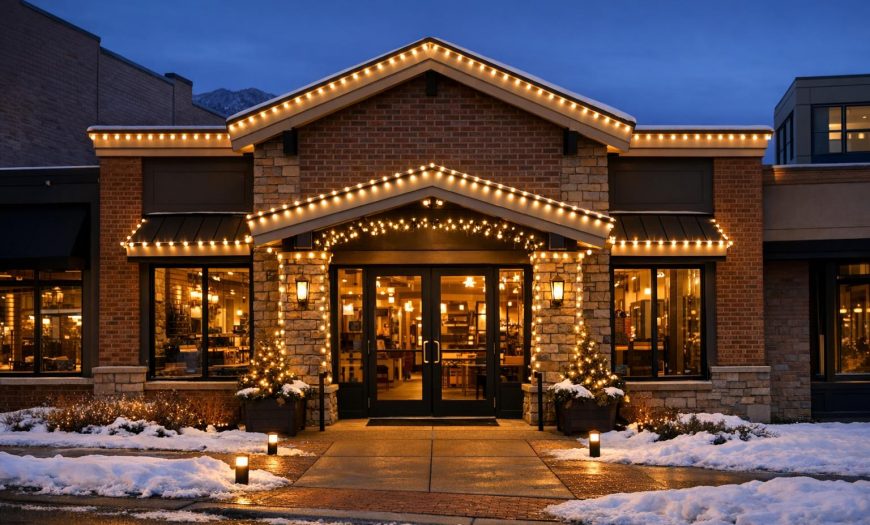
Turn seasonal décor into “follow-the-lights” visibility for your storefront
During the holidays, Denver gets busier, darker earlier, and more visually crowded. If customers can’t spot your entrance, parking direction, or storefront from the street, they’re more likely to keep driving. Strategic holiday lighting solves that problem by acting as wayfinding—subtle visual cues that help people find you quickly, safely, and with a better first impression.
What “wayfinding lighting” means for a holiday display
Wayfinding lighting is any lighting plan that helps a person answer three questions in seconds: “Where am I?”, “Where do I go?”, and “Am I in the right place?” For a Denver storefront, that can include lighting that emphasizes your brand sign, outlines the building’s shape so it stands out from neighboring businesses, and clearly marks the path from sidewalk to door.
Holiday lighting works especially well because it’s naturally attention-getting—but the best results come from controlling placement, brightness, color temperature, and direction so the design attracts customers without creating glare, confusion, or light spill into nearby properties. DarkSky International’s responsible lighting principles emphasize using light only where needed, shielding it, and using warmer color temperatures when possible. (darksky.org)
The 5 “Wayfinding Zones” to light for a Denver business
1) The “Spot-Me” Zone (street visibility)
This is the view from the road—drivers and pedestrians need to identify your storefront fast. Crisp roofline outlines, columns, and window framing give your building a clean silhouette. If your unit sits in a row of businesses, outlining your façade can separate you from the visual noise.
2) The “Confirm” Zone (sign + brand touchpoints)
Customers often find the right block, then hesitate because they’re not 100% sure it’s you. Lighting that gently supports your sign area and entry canopy helps customers confirm they’ve arrived—without washing out the sign face or creating harsh glare.
3) The “Go-Here” Zone (entry + doorway)
Your entrance should be the brightest “destination point,” but not blinding. A tasteful doorway frame, wrapped columns, or lit garland around the entry creates an intuitive “this is the door” cue, especially helpful for first-time visitors or evening appointments.
4) The “Move-Safely” Zone (walkways, stairs, and ramps)
This is where you prevent slips, missed steps, and awkward navigation. The goal is even, downward-directed illumination that reduces shadow pockets and glare. Outdoor lighting guidance from the National Park Service highlights shielding and directing light downward onto the task area to reduce spill and improve comfort. (nps.gov)
5) The “Stay-Or-Go” Zone (parking + pickup points)
If you have a lot, alley entrance, or designated pickup zone, holiday lighting can highlight the correct driveway and reduce wrong-turns. Think subtle perimeter lighting and clear “landing points” rather than random bright clusters.
Design choices that make wayfinding work (not just look festive)
Control glare and light spill
Glare is the enemy of navigation. If passersby see the light source more than the lit surface, your display can feel harsh and make signs harder to read. DarkSky’s principles emphasize shielding and aiming light so it lands where it’s needed—walkways, entrances, and façades—rather than into eyes, windows, or the sky. (darksky.org)
Use warmer color temperatures for comfort
Warmer whites (lower Kelvin ratings) often feel more welcoming and can reduce the “blue-ish” brightness that makes outdoor areas feel stark. DarkSky recommends using warmer-color lights where possible. (darksky.org)
Prioritize vertical surfaces for visibility
Lighting vertical elements (windows, columns, entry features) makes a storefront readable from a distance because people see it head-on. Retail and façade lighting guidance commonly notes that lighting helps storefronts and shop windows remain visible in their surroundings. (erco.com)
Did you know? Quick wayfinding facts for holiday business lights
Downward-directed light improves comfort and reduces sky glow—shielding is a key principle for responsible outdoor lighting. (nps.gov)
Higher color temperatures can appear “brighter” and contribute more short-wavelength (blue) light; warmer options can look more inviting around entrances. (nps.gov)
UL 588 is the commonly referenced standard for seasonal and holiday decorative products, including decorative lighting strings. (ul.com)
Holiday lighting options for Denver storefront wayfinding (comparison table)
| Lighting element | Best wayfinding job | Where it works best | Watch-outs |
|---|---|---|---|
| Roofline outline | “Spot-me” from the street | Retail strips, corner units, multi-tenant buildings | Avoid overly bright hotspots near neighbors’ windows |
| Entry framing (door/columns) | “Go-here” cue | Clinics, salons, restaurants, office lobbies | Keep sightlines comfortable—avoid glare into approaching customers |
| Window outlining or subtle perimeter accents | “Confirm” you’re in the right spot | Showrooms, boutiques, street-facing offices | Don’t reduce interior visibility with reflections |
| Walkway and step lighting | “Move-safely” navigation | Any site with stairs, ramps, uneven paving | Aim downward and shield to reduce glare. (nps.gov) |
| Tree wraps near entrance | Natural “beacon” landmark | Properties with street trees or plaza landscaping | Keep it consistent—random trees can confuse direction |
Step-by-step: Build a storefront wayfinding plan that looks great
Step 1: Identify the customer approach paths
Stand where first-time customers approach: across the street, at the nearest intersection, and in the parking lot. Note what’s visually competing with you (neighbor signage, streetlights, reflective glass, tree branches).
Step 2: Choose one “hero” cue and two “support” cues
A strong plan is simple: one primary element (often roofline or entry frame) plus two supporting elements (window outline + tree wrap, for example). This creates a visual hierarchy customers can understand quickly.
Step 3: Keep brightness consistent and comfortable
Avoid mixing one extremely bright element with everything else dim—people’s eyes lock onto the brightest point, which can accidentally pull attention away from the entrance. Shielded, well-aimed light helps minimize glare and helps shoppers see where they’re going. (nps.gov)
Step 4: Plan for safety and reliability (especially outdoors)
Seasonal decorative lighting is exposed to wind, moisture, and temperature swings. UL notes that lights certified to UL 588 are evaluated with tests such as rain, water immersion, and UV exposure to help reduce risks like fire or electric shock when used as intended. (ulse.org)
Step 5: Use timers and a predictable schedule
Consistency builds recognition. If your display is on during your busiest evening hours, returning customers will “pattern match” your storefront from a distance. It also helps staff and neighbors know what to expect.
Local angle: what makes Denver storefront lighting different
In the Denver metro, holiday displays have to perform in real-world winter conditions—temperature swings, wind, and occasional snow and ice. Wayfinding matters more when people are moving quickly from car to door, bundled up, and watching their footing. A clean lighting plan that highlights the entry and reduces glare is more than a nice detail; it supports safer customer flow.
If your business sits in a busy retail corridor, you’re also competing with brighter signage and heavy traffic lighting. That’s where a “designed” holiday look stands out: cohesive lines, balanced brightness, and a clear focal point at the entrance.
Ready to make your holiday lights work like a sign, a guide, and a welcome mat?
Denver Christmas Light Installers designs, installs, maintains, removes, and stores custom holiday lighting for Denver-area residential and commercial properties—so your display stays safe, sharp, and easy for customers to follow.
FAQ: Wayfinding holiday lighting for Denver businesses
What’s the biggest mistake businesses make with holiday business lights?
Treating the display like “random sparkle” instead of a plan. Wayfinding needs a clear visual hierarchy: a standout entry cue, supporting building outlines, and comfortable lighting on paths.
How do I make my Denver storefront easier to find without blinding drivers?
Focus on lighting surfaces (rooflines, columns, façade details) rather than exposing light sources directly. Shielding and aiming light downward reduces glare and improves comfort. (nps.gov)
Are color-changing lights a good idea for wayfinding?
They can be, if you use them intentionally. Keep the entry consistent (so it’s always the “destination”), and use color-changing effects as accents rather than the main navigational cue.
What safety standard should I look for with seasonal decorative lighting?
Many seasonal decorative lighting products are evaluated to UL 588 (seasonal and holiday decorative products). Using properly rated products and professional installation helps reduce electrical and fire risks in outdoor conditions. (ul.com)
How early should a Denver business schedule holiday light installation?
Earlier is better—commercial schedules fill quickly. Planning early also gives time to design a wayfinding layout that matches your building and customer flow instead of defaulting to a last-minute, less effective setup.
Where can I see examples of displays that highlight entrances and rooflines?
Browse our project photos for commercial and residential ideas in the Denver Christmas Light Installers gallery.
Glossary (helpful holiday lighting terms)
Wayfinding: Design cues (including lighting) that help people navigate to an entrance, path, or destination without confusion.
Glare: Uncomfortable brightness that makes it harder to see details (often caused by exposed bulbs or poorly aimed fixtures).
Shielded lighting: Lighting designed/positioned so the light is directed downward onto the intended area instead of into eyes or the sky. (nps.gov)
Color temperature (Kelvin, K): A way to describe how “warm” (more amber) or “cool” (more blue/white) light appears; warmer light is often recommended for responsible outdoor lighting when possible. (nps.gov)
UL 588: A UL standard commonly referenced for seasonal and holiday decorative products, including decorative lighting strings. (ul.com)

Leave feedback about this